
How DC Fast Chargers Work — From OCPP to CCS2
A non-technical guide to the protocols, hardware, and software that power 120kW to 480kW ultra-fast public charging stations.

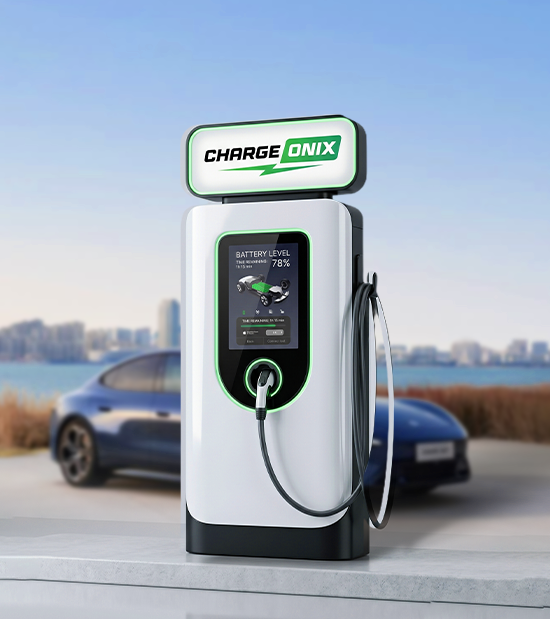
Inside A DC Fast Charger
A 120kW DC fast charger looks like a simple box, but inside it's a tightly integrated power plant. At its core are: (a) an AC-to-DC power module stack (usually 20kW × 6 for 120kW); (b) a liquid cooling system for the power electronics; (c) an OCPP-enabled charge controller with 4G/Wi-Fi; (d) a payment terminal with RFID, QR, and contactless card support; and (e) output contactors rated for up to 500A. Chargeonix™ chargers additionally include a custom load-balancing chip that communicates with the site's EMS to avoid peak-demand penalties.
The CCS2 Connector And Handshake
CCS2 (Combined Charging System, version 2) is the standard used by almost every 4-wheeler EV in India. When you plug in, 7 small pins at the bottom communicate first: they identify the car, its battery capacity, current State of Charge (SoC), and the maximum charge rate the BMS will accept. Only after this digital handshake is complete do the two big DC pins at the top energize — this is why plugging into a CCS2 charger is always safe, even in the rain.

What Is OCPP? The Language Of Chargers
OCPP (Open Charge Point Protocol) is the open standard that lets chargers from different manufacturers talk to backend CMS platforms like Chargeonix™ Cloud. Think of it as 'Wi-Fi for chargers.' OCPP 1.6 JSON over WebSockets is the dominant variant in India today, with OCPP 2.0.1 rolling out for our next-gen 240kW and 480kW stations. It handles: remote start/stop, real-time meter values, firmware updates, diagnostics, reservation, and smart charging profiles.
Charge Curve: 0–80% vs. 80–100%
You've probably noticed that an EV charges very quickly to 80% and then slows down. This is by design. Batteries accept high current when the cells are empty (0–80% SoC), but to prevent lithium plating and thermal stress, the BMS tapers current as SoC rises. A 120kW Chargeonix™ station charges a typical 60kWh SUV from 10% to 80% in about 30 minutes. The last 20% takes another 20 minutes — this is why public stations are optimized for 0–80% top-ups during stops, not full charges.
Load Balancing & Grid-Friendly Charging
A petrol pump or mall upgrading to 4 DC fast chargers would otherwise need a costly 500kVA sanctioned-load upgrade. Chargeonix™'s dynamic load balancing aggregates all chargers on the site plus the existing building load, and caps the total draw at any pre-set limit. In practice, this means you can deploy 4 chargers with only a 200kVA connection, with full utilization when other building loads are low (nights, weekends).